Action Potentials: How Your Neurons Fire and Wire
- Pamela Brown

- Nov 17, 2025
- 5 min read
Updated: Nov 18, 2025
Have you ever wondered how your brain turns a thought into a movement? Or how you remember someone’s face in a crowd? What blows my mind is that there is a constant symphony of electrical and chemical activity happening inside your skull.... as in right now and as you read this sentence. Thoughts are not intangible. You may not be able to touch them, but they are physical events - tiny measurable changes in voltage. And at the very heart of every thought, every memory, every breath you take is one process: the action potential. Without it, there would be no thinking. No movement. No heartbeat. You would simply… stop.
What Is an Action Potential?
In the simplest terms, an action potential is a rapid rise and fall in electrical charge across the membrane of a neuron. It is a literal spike of electricity, a pulse of voltage, generated and transmitted along neurons. The mechanism was first worked out in 1952 by Alan Hodgkin and Andrew Huxley using squid neurons. Their findings earned them the 1963 Nobel Prize in Physiology or Medicine, and their mathematical model still underlies modern neuroscience.
Before the Spark: Resting Membrane Potential
When a neuron is not firing, it sits at around –70 millivolts (mV). That number exists because of a combination of electrostatic forces (opposite charges attracting and like charges repelling, diffusion forces (ions moving from area of high concentration to low), and the sodium–potassium pump, which constantly pumps 3 sodium ions out and 2 potassium ions in. Altogether, this creates a charged separation, like a stretched bowstring full of potential energy.
The Threshold
Though the membrane potential can change, nothing happens until the neuron reaches about –55 mV, This is known as the threshold potential. It usually reaches this voltage as a result of neurotransmitters affecting and opening ion channels on dendrites, allowing positive ions to enter the neuron.
However, once threshold is reached the neuron fires. It happens at once. It doesn't slowly work up to it or half fires. It's all or nothing. There are no half-action potentials.
Phases of an Action Potential
There are several main phases of the action potential which we will briefly discuss.
First is the depolarization. During depolarization, voltage-gated sodium (Na⁺) channels open and sodium floods in causing the membrane charge to quickly rise to ~+30 mV.
Next is the repolarization phase. The Na⁺ channels close, but voltage-gated potassium (K⁺) channels open. The allows potassium to leave the cell, making the membrane less negative again.
Finally there is the hyperpolarization or refractory period. The cell overshoots its resting potential and becomes slightly more negative than usual.
But once the K+ channels closed, the membrane returns to –70 mV as pumps reset the balance.
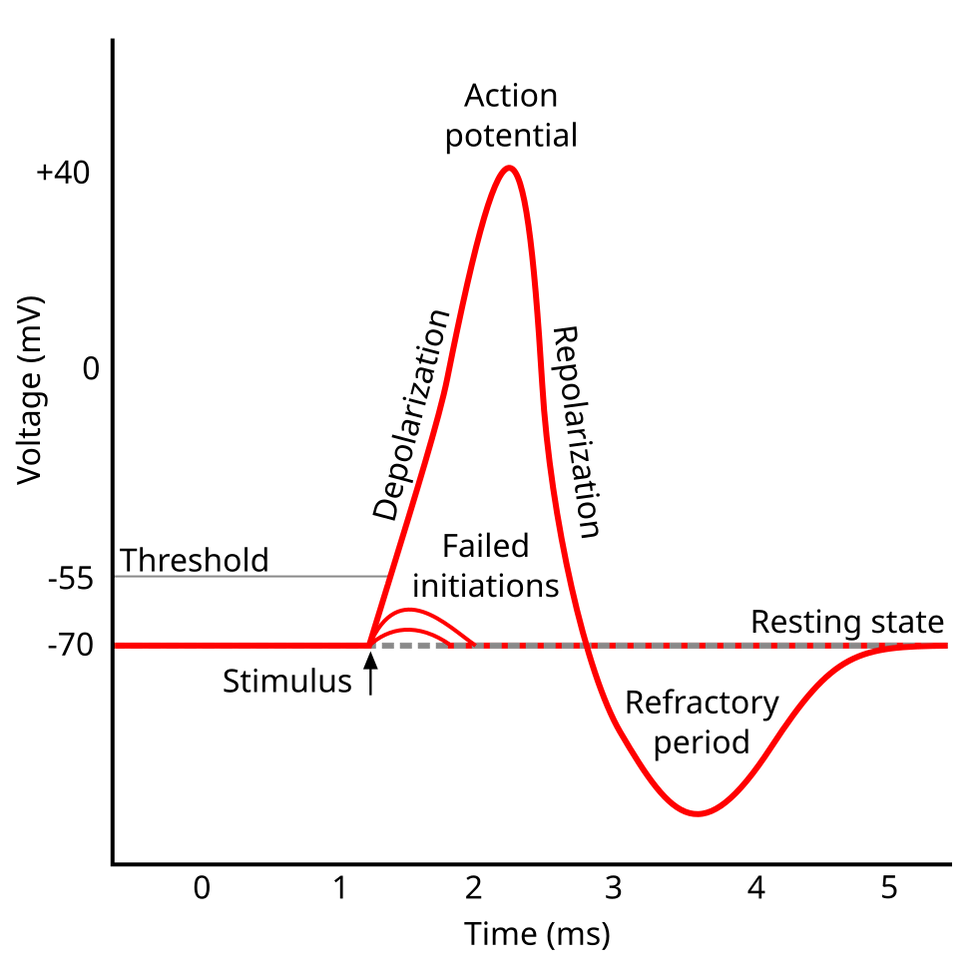
Action potential diagram by Helixitta, Wikimedia Commons, CC BY-SA 4.0.
How the Signal Travels — Saltatory Conduction
Once the action potential starts at the axon hillock, it must travel down the axon. But it doesn’t slowly creep along like a fuse. It uses one of biology’s speed hacks - saltatory conduction. Many axons are wrapped in myelin, a fatty electrical insulator. The myelin isn’t continuous but is broken into segments separated by tiny gaps called Nodes of Ranvier.
Here’s what happens:
The action potential only regenerates at the nodes.
Under the myelin, the voltage spreads rapidly forward inside the axon.
The signal appears to jump from node to node like stepping stones.
That jumping motion is what saltatory means. It's from the Latin saltare meaning "to leap". Myelin allows an increase in speed (up to 120 m/s vs. 1–10 m/s without), saves energy (fewer ions need to be pumped), and enables long wiring (lets your brain signal muscles far away the head) .
A metaphor that helps: Imagine a stadium doing the wave. If every person had to stand in sequence, it would be slow. But if every tenth person stood, the wave would whip around the arena. Myelin turns your neurons' axons into that fast stadium. When saltatory conduction breaks, such as in multiple sclerosis where myelin degrades, the "jumping" system collapses and the neural signals slow or even fail.
Why This Matters
When the action potential reaches the axon terminal, it triggers the release of neurotransmitters into the synapse. Those neurotransmitters can in turn start the next action potential in another neuron, activate a muscle, release a hormone, store a memory and so on.
This electrochemical chain - electrical (down the neuronal axon) → to chemical (neurotransmitters released from the axon terminal of one neuron and picked up by the synaptic terminal of a nearby neuron's dendrites) → to electrical (causing a new action potential) - is how all nervous system communication works. If action potentials stopped, you would be unconscious in milliseconds.
When Action Potentials Go Wrong
When action potentials don’t work properly, the consequences can be serious. There is the aforementioned multiple sclerosis where the myelin coating around axons breaks down, slowing or stopping the electrical “jumping” process, which leads to muscle weakness, numbness, and loss of coordination. In epilepsy, neurons become overly excitable and fire action potentials too easily and in synchronized bursts, resulting in seizures. In ALS, motor neurons gradually lose their ability to fire properly, leading to progressive paralysis. And in some rare genetic channelopathies, mutations in sodium channels prevent action potentials from starting at all, disrupting movement, sensation, and even breathing. When the basic electrical signal of the nervous system breaks down, everything built on it begins to fail.
What Modern Research Shows
Modern neuroscience continues to refine how we understand this electrical signal.
A highly cited review from Bruce Bean (2007, Nature Reviews Neuroscience)* found that different types of neurons fire differently, not because the basic mechanism changes, but because their ion channels are tuned differently. That means some neurons fire rapid repeated spikes, others fire once and stop, and some use additional ion types (like Ca²⁺) to shape their firing patterns. The rules are universal, but neurons play different songs with them. This reinforces one core idea of your nervous system. The action potential is a universal code, but biology bends and shapes it for every task, from heartbeat rhythm to language, memory, and movement.
*Reference: Bean, B. P. (2007). The action potential in mammalian central neurons. Nature Reviews Neuroscience, 8, 451–465.
Try It Yourself: A Reaction Speed Test
If you want to try to feel your action potentials at work, try this experiment: Hold your hand next to a ruler someone else is holding vertically. When they drop it without warning, catch it as fast as possible. The distance it falls is related to your neural signal speed. This measurement includes sensory action potentials (from eye to brain) and motor action potentials (from brain to muscle). Try it at different times of day such as before and after coffee, when tired, and using a sound instead of sight to see how the times compare. Your nervous system is not constant, and now you know why.
Final Thought
Every time you read, breathe, blink, remember, or pick up your coffee, billions of tiny voltage spikes fire through your neurons in perfect sequence, creating the physical basis of your mind. Your thoughts aren’t invisible magic. They are electricity. They are physical events. And that, to me, is even more beautiful. An important takeaway from this is that because thoughts ARE physical, they literally reshape your brain. The more you think a certain way, the more your neurons strengthen those pathways. In other words, the brain "wires" itself around what you repeatedly think about. So be careful which thoughts you allow to grow stronger. . . You are, quite literally, what you think.



Comments